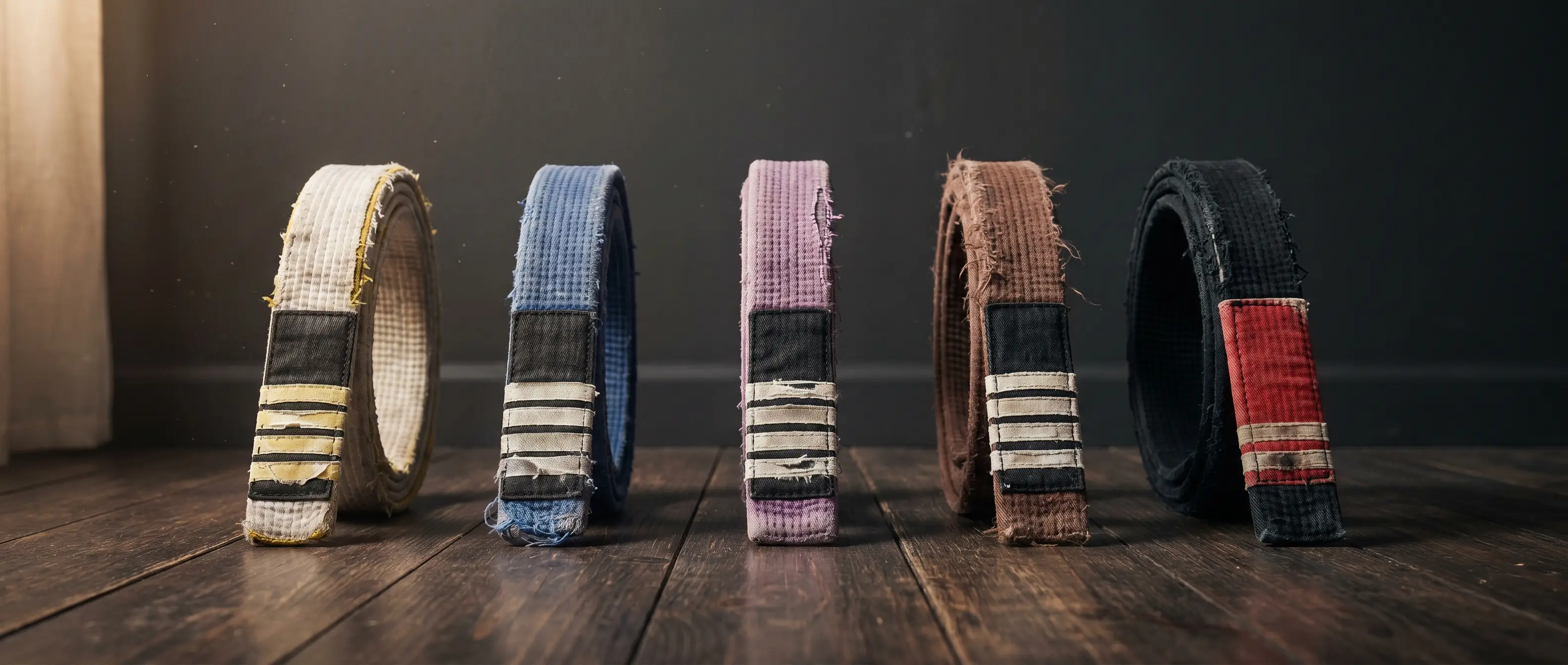
Brazilian Jiu-Jitsu has one of the most demanding belt progression systems in martial arts. While a student can earn a black belt in Karate or Taekwondo in 3–5 years, the average BJJ black belt takes 10 to 15 years — and that's training consistently, multiple times per week. The belt system isn't just a ranking structure; it's a reflection of genuine technical depth and the thousands of hours required to build it.
Here's everything you need to know about how the BJJ belt system works — for adults and kids, with and without stripes.
Adult Belt Progression
Typical adult timelines (IBJJF minimums apply; actual times vary by training frequency)
Adult Belt Order
The adult BJJ belt system has five main competitive belts, followed by three post-black belt ranks reserved for the most senior practitioners.
| Belt | Colour | Typical time | What it represents |
|---|---|---|---|
| White | 0–2 years | Beginner. Learning to survive, understanding positions and basic submissions. | |
| Blue | 2–5 years | Solid foundation. Can execute core techniques and understand positional hierarchy. | |
| Purple | 5–8 years | Intermediate. Developing a personal game. Often begins teaching. | |
| Brown | 8–12 years | Advanced practitioner. Refining and tightening. Preparation for black belt. | |
| Black | 12+ years | Expert. Deep technical knowledge and significant teaching ability. |
Stripes: The System Within the System
Each belt (white through brown) can have 0 to 4 stripes awarded before a full belt promotion. Stripes are applied with tape to the black end of the belt, and are awarded at the instructor's discretion.
What stripes signal:
- They're an intermediate recognition that acknowledges progress without awarding a full belt change.
- They help students understand where they are in the journey to their next belt.
- Not all gyms use stripes the same way — some use them formally and consistently, others award them loosely, and some experienced instructors barely use them at all.
There's no universal rule about when to award a stripe. An instructor might give a stripe at 25 sessions, or when a student has shown improvement in a particular area of their game, or simply when they feel like the student deserves acknowledgement.
The Kids Belt System
Students under 16 train through a separate kids belt system designed to provide more frequent progression milestones appropriate for younger learners. The kids system includes:
- White — starting point
- Grey (white/grey and grey)
- Yellow (white/yellow and yellow)
- Orange (white/orange and orange)
- Green — the highest kids belt
Each of these belts (except white) has two variations — a split belt (e.g. white/grey) and the solid colour. This gives more granular progression steps over the years. At 16, students transition into the adult system, typically starting at white belt regardless of their kids belt level, though many gyms award an early blue based on demonstrated skill.
The kids system exists because children need more frequent recognition to stay motivated. A 9-year-old who's told they won't get a new belt for 18 months is a 9-year-old who might not make it to 10.
What Makes BJJ Different
Unlike most other martial arts, there's no universal BJJ syllabus. An instructor doesn't have a checklist of 20 specific techniques that, when learned, grant a blue belt. The IBJJF does set minimum time requirements (e.g. a practitioner must train for at least 1 year before receiving a blue belt), but technical criteria are entirely at the instructor's discretion.
This is both a strength and a weakness of the BJJ system. It allows for genuine assessment of overall game and character, rather than checkbox performance. But it also means that without formal structure, promotion decisions can be inconsistent — or worse, influenced by who the student is rather than what they can do.
Coral and Red Belts
Beyond the competitive black belt are three honorary ranks for the most senior figures in the art:
- Coral belt (red/black) — awarded at 7th degree black belt. Practitioners who've spent decades teaching and contributing to the sport.
- Coral belt (red/white) — 8th degree. Typically awarded to practitioners with 30+ years at black belt.
- Red belt — 9th and 10th degree. Reserved for the grandmasters of the art — the founders and their most direct, senior descendants. Only a handful of people hold this rank. It's as much a lifetime-achievement award as a technical rank.
Tracking It All Automatically
ClubEasy tracks every student's belt, stripes, time in rank, and promotion history automatically. Each member has a full belt timeline — visible to instructors and to the member themselves — showing every belt they've received, when, and who approved it. No more guessing. No more lost paper records. Just a clean, permanent history of every step of their BJJ journey.